
Beyond Amazon: How Brands Unlock Cross-Border Growth on Europe’s Marketplaces
Amazon remains Europe’s dominant marketplace. For many brands, however, it has become a concentration risk rather than a sustainable growth engine.
Expanding beyond Amazon is not about replacing it. It is about strengthening growth resilience, diversifying revenue streams, and building a structured multi-marketplace strategy across Europe.
This masterclass provides a practical framework for brands evaluating expansion beyond Amazon in a fragmented European landscape.

Key insights from the masterclass
The next wave of marketplace growth in Europe is happening beyond a single platform. Brands that scale successfully understand both the commercial opportunity and the operational complexity behind cross-border expansion.
- Europe’s marketplace ecosystem is highly fragmented
- Platform dependency creates structural risk
- Expansion requires operational, fiscal, and technical readiness
- Different expansion models optimize for different priorities
- Portfolio thinking is replacing single-platform strategies
Why brands are looking beyond Amazon
Marketplace pressure is increasing, while diversification opportunities are expanding.
Pressure is increasing
Many brands face:
- rising advertising pressure
- increasing competition and margin compression
- growing operational complexity
- platform concentration risk
Diversification unlocks growth
Expanding beyond Amazon enables:
- revenue diversification
- access to lower-competition pockets
- stronger pricing control
- reduced platform dependency
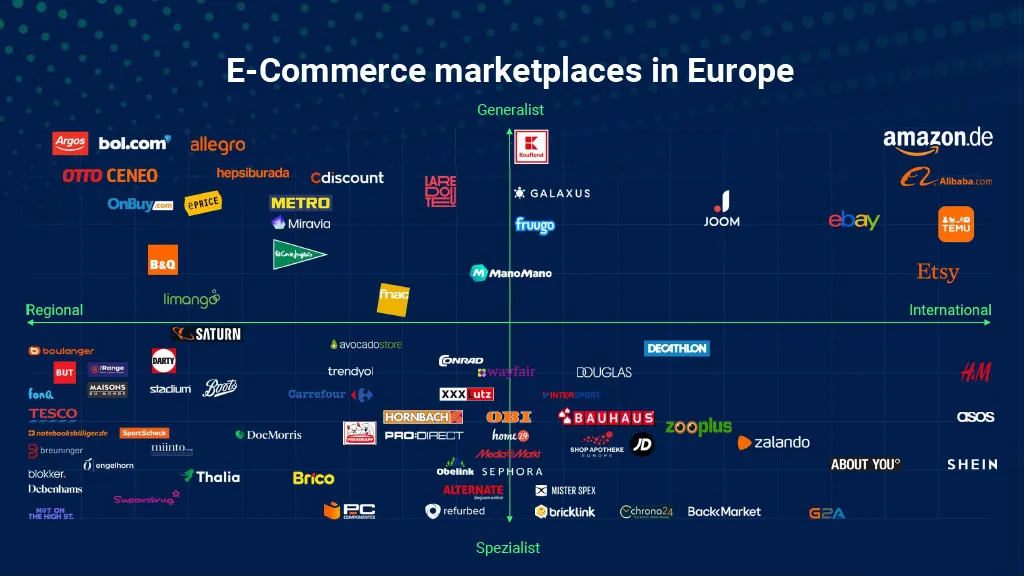
Europe is not one marketplace
Unlike the US, Europe operates as a fragmented marketplace ecosystem. Each country and category has its own local leaders, access models, fulfillment expectations, and regulatory requirements.
Successful expansion depends not only on onboarding additional marketplaces, but on selecting the right operating model and building cross-border infrastructure from the start.
Three common approaches to marketplace expansion
There is no universal model for European marketplace growth. Each approach optimizes for a different priority.
Inhouse model
Build and operate internally.
👉 Optimizes for: Control & ownership
👉 Trade-off: : High internal complexity
Reseller / Distributor model
Delegate to local partners.
👉 Optimizes for: Simplicity & lower operational effort
👉 Trade-off: Limited pricing and brand control
Merchant of Record model
Outsource infrastructure while retaining strategic direction.
👉 Optimizes for: Scalable expansion
👉 Trade-off: Shared margin model
Case Study: Target Darts
Target Darts, a leading UK brand in the darts category, aimed to reduce Amazon dependency and expand its European presence beyond a single platform.
Through a phased approach, the brand launched on bol.com in the Netherlands and Belgium, then expanded into Germany, France, and Poland, adding Decathlon, Allegro, Cdiscount, and Kaufland.
Within five months, the brand achieved six-digit monthly revenue and approximately 80 percent month-over-month growth while significantly reducing single-platform exposure.

Access the full masterclass slides
The complete presentation provides a structured framework for evaluating marketplace expansion beyond Amazon, including landscape analysis, operating model comparison, and a real expansion case study.
Fill in your details below to download the slides.